The original Tillman post office
The Tillman post office opened in 1885 and operated until the 1925 rename to Palm Bay. The post office was the village's first piece of federal infrastructure and the reason the place had a recognized name at all. The original building's exact location is not documented in surviving records.
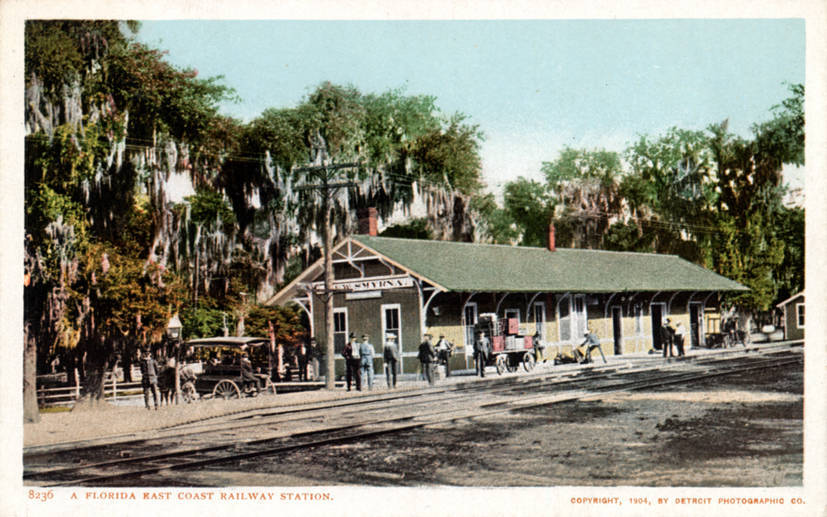
The Tillman post office opened in 1885. The U.S. Post Office Department, the federal agency that became the USPS in 1971, approved an application from a local resident, appointed that resident as postmaster, and authorized service for the small community on the west bank of the Indian River that would become Palm Bay 40 years later.
The post office operated continuously from 1885 through 1925, with various postmasters succeeding each other across that period. In 1925 the post office name was changed from Tillman to Palm Bay, in the federal-record action that completed the community’s 1925 name change.
How a Florida post office got established in 1885
The federal procedure for establishing a small post office in the late 19th century was straightforward. A local resident, usually a merchant or planter or other prominent local figure, submitted an application to the Post Office Department in Washington. The application identified the proposed location, the nearest existing post office, the proposed name, and the applicant himself as proposed postmaster. The application included a brief justification for service and a survey of the local population that would use the office.
Washington reviewed applications based on a standard set of criteria. Was there sufficient population to warrant service? Was the proposed location reasonably distant from existing offices? Was the postmaster qualified (in practice, this usually meant the applicant was literate, had a fixed address, and could provide a building or part of a building for the office)? If approved, the Post Office Department issued the postmaster an appointment, established mail routes connecting the new office to the network, and opened service.
The applicant for the Tillman post office, as best the federal records establish, was a local resident named Tillman. The standard practice was that a successful applicant could name the new office, usually after himself, his wife, or a local feature. The Tillman name reflects the standard pattern. The applicant’s full name and the specific details of his application are not fully documented in publicly accessible federal records; the postal archives contain the basic establishment record but the application file itself, if it survives, would be in the National Archives in Washington.
What “post office” meant in 1885
The 1885 Tillman post office would have been a single room in someone’s house or store. There was no dedicated post office building. The postmaster operated as a side function alongside his primary business or residence. Mail came in by horseback or by river from the nearest larger post office (probably Eau Gallie or Melbourne) and was distributed by the postmaster either by handing it to residents who came to collect it or, where the postmaster knew his clientele well, by occasional informal delivery.
The volume was modest. A community of a few dozen families generated a few dozen pieces of mail per week. Outgoing mail was held until the next pickup; incoming mail was held until the addressee came to collect it. The standard nineteenth-century rural post office operated on this pattern.
The Tillman post office’s compensation to its postmaster was minimal. Postmasters in small post offices were paid based on a fee system tied to the volume of mail handled. A Tillman-scale post office would have generated postmaster compensation in the range of a few hundred dollars per year, supplementing whatever other income the postmaster derived from his primary occupation.
The succession of postmasters
The federal records list a succession of Tillman postmasters across the 1885-1925 period. The specific names and dates would require National Archives research to fully reconstruct; the readily-available digitized records cover the main establishment and discontinuance events but not necessarily every intermediate postmaster appointment.
The pattern in rural Florida post offices of this period was that postmasters served for various lengths of time and resigned or died and were replaced through new Post Office Department appointments. There was no formal civil service for small post offices; appointments were political at the federal level and practical at the local level.
By 1925 the Tillman post office had been operating for forty years through various postmasters. The 1925 renaming was applied to the existing office and continued under the new Palm Bay name. The same physical operation, possibly in the same building, with the same incumbent postmaster (whose exact identity at the 1925 changeover is not in the readily-available records) continued to serve the community.
Where the Tillman post office was located
This is the gap in the record we cannot fill. The specific physical location of the Tillman post office, the building or store or residence that housed it, is not documented in any publicly accessible source we have located.
The likely options are limited. The settlement that was Tillman occupied a relatively small footprint on the western bank of the Indian River. The post office had to be reasonably accessible to the population it served. It was most likely in one of the two or three commercial structures that operated in the village across the post office’s 40-year life, or in the postmaster’s residence at various points.
The structures themselves are gone. The Tillman-era buildings did not survive Palm Bay’s 20th-century development. None of the surviving Palm Bay structures dates back far enough to have been the Tillman post office.
Brevard County’s local historical society and the City of Palm Bay’s own historical materials do not specifically identify the building. The City history page mentions the post office’s establishment without providing a building location. The local historical literature on Tillman is thin enough that the location may never have been formally recorded in a way that has survived to the present.
The records that do exist
What we have, in the documentary record, is:
The federal establishment date of 1885 for the Tillman post office.
The federal renaming date of 1925, when the office became Palm Bay.
References in Florida Memory and other archives to the post office’s operations during its 40-year existence.
Local references in Brevard County historical materials acknowledging the post office’s existence and importance.
The Bradbury and Hallock chronology of Florida post offices, which lists the office’s basic establishment and discontinuance information.
What we don’t have, at least not in readily-accessible form:
The specific building location.
A complete list of postmasters across the 40-year period.
Photographs of the office or the postmaster.
Direct documentary records (correspondence, ledgers, mail volume data) from the office’s operations.
These items may exist in the National Archives’ Record Group 28 holdings on the U.S. Post Office Department. Accessing them would require physical research at the National Archives or one of its regional facilities; the digitized portion of these records is incomplete for small Florida post offices of this period.
Why the post office mattered
The Tillman post office mattered, civically and economically, because it gave the community a recognized federal-government presence. A post office made the place real on maps. A post office allowed mail-order shopping (which was becoming significant for rural Americans in the 1880s and 1890s through Sears Roebuck and similar catalog operations) to deliver goods to the community. A post office connected Tillman residents with family, business correspondents, and the broader American postal system that was the basic communications infrastructure of the era.
Without the Tillman post office, the settlement would have continued to exist but as a less defined entity. Mail to Tillman residents would have come via Eau Gallie or Melbourne. The community’s identity as a discrete place would have been less established. The probable consequence is that the settlement might have been informally absorbed into one of its neighbors before the 1920s, with no surviving distinct identity to carry forward into the Palm Bay era.
The post office was the village’s first piece of federal infrastructure and, for most of its 40-year run, its only piece. The school was county. The roads were county. The Justice of the Peace was county or state. The post office was federal. That federal presence anchored the community’s identity until the city government took over that role in 1960.
The transition to Palm Bay
In 1925 the post office, the federal establishment that had created the Tillman name, became the federal establishment that created the Palm Bay name. The transition was administrative; the same office served the same population through the same operations under a new name. The postmaster of the moment continued. The mail kept flowing. The location, wherever it was, did not move.
The original Tillman post office is gone in every meaningful sense, the building, the operations, the era, the population it served. What remains is the federal record that it existed, and the name that briefly identified an Indian River settlement that has since been completely absorbed into the city Palm Bay became.
Further Reading
As an Amazon Associate we earn from qualifying purchases.