Turkey Creek Sanctuary: the freshwater spring the Ais came for
Turkey Creek Sanctuary is 130 acres of preserved hammock, swamp, and freshwater spring run on the eastern edge of Palm Bay. It's the last largely-intact piece of the landscape the Ais people fished and the 19th-century settlers fished after them. It's also a small refuge inside a city built by draining everything around it.
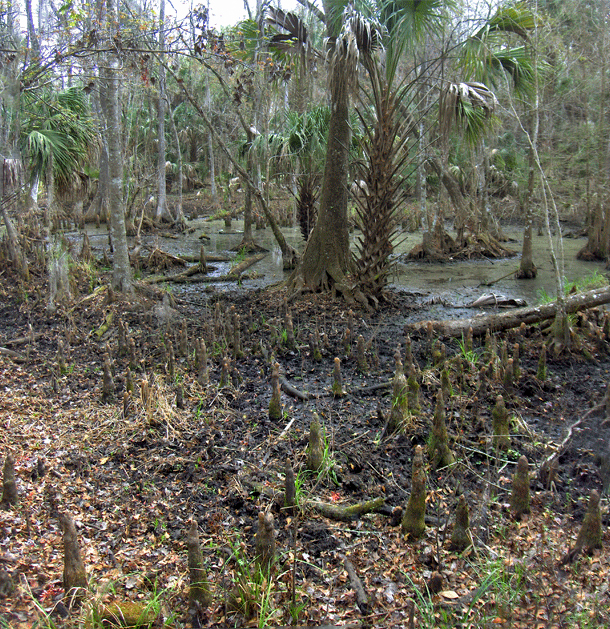
Turkey Creek Sanctuary covers 130 acres at Palm Bay’s northeast corner, between Port Malabar Boulevard and the creek’s lower reach. The Sanctuary includes a hardwood hammock, a cypress floodplain, and the lower portion of the freshwater spring run that gave the creek its hydrological importance for the Ais, for 19th-century settlers, and for the modern city.
It’s the smallest meaningful piece of Palm Bay’s pre-development landscape that’s still recognizable. Everything around it has been drained, platted, paved, or all three.
What it preserves
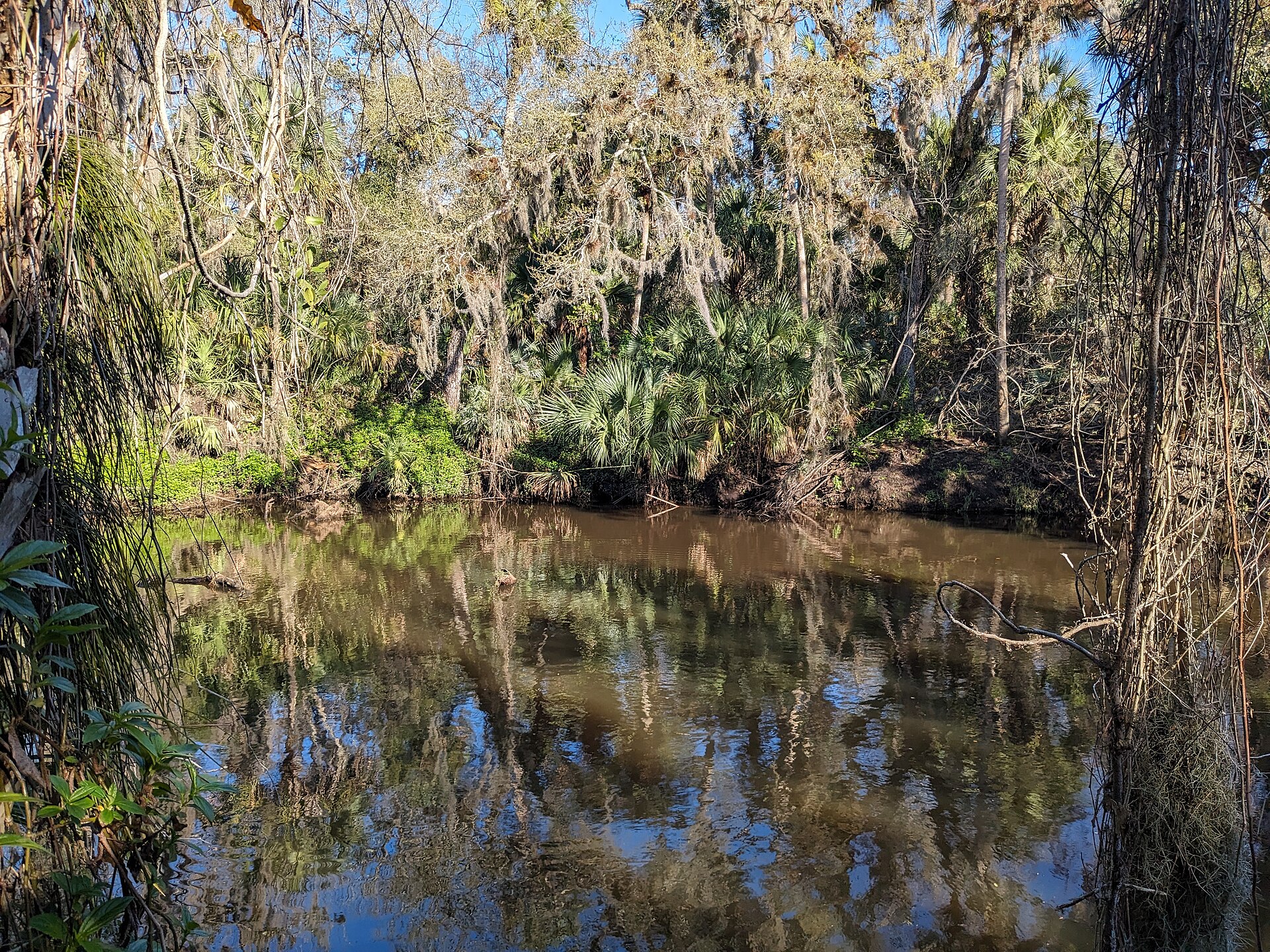
The Sanctuary’s core habitat is the freshwater run of upper Turkey Creek. Limestone-bottomed pools deliver clear water from springs that surface a few miles inland. The water moves slowly through a corridor of cypress, palm, and live oak hammock toward the creek’s confluence with the Indian River Lagoon a half-mile downstream of the Sanctuary’s eastern boundary.
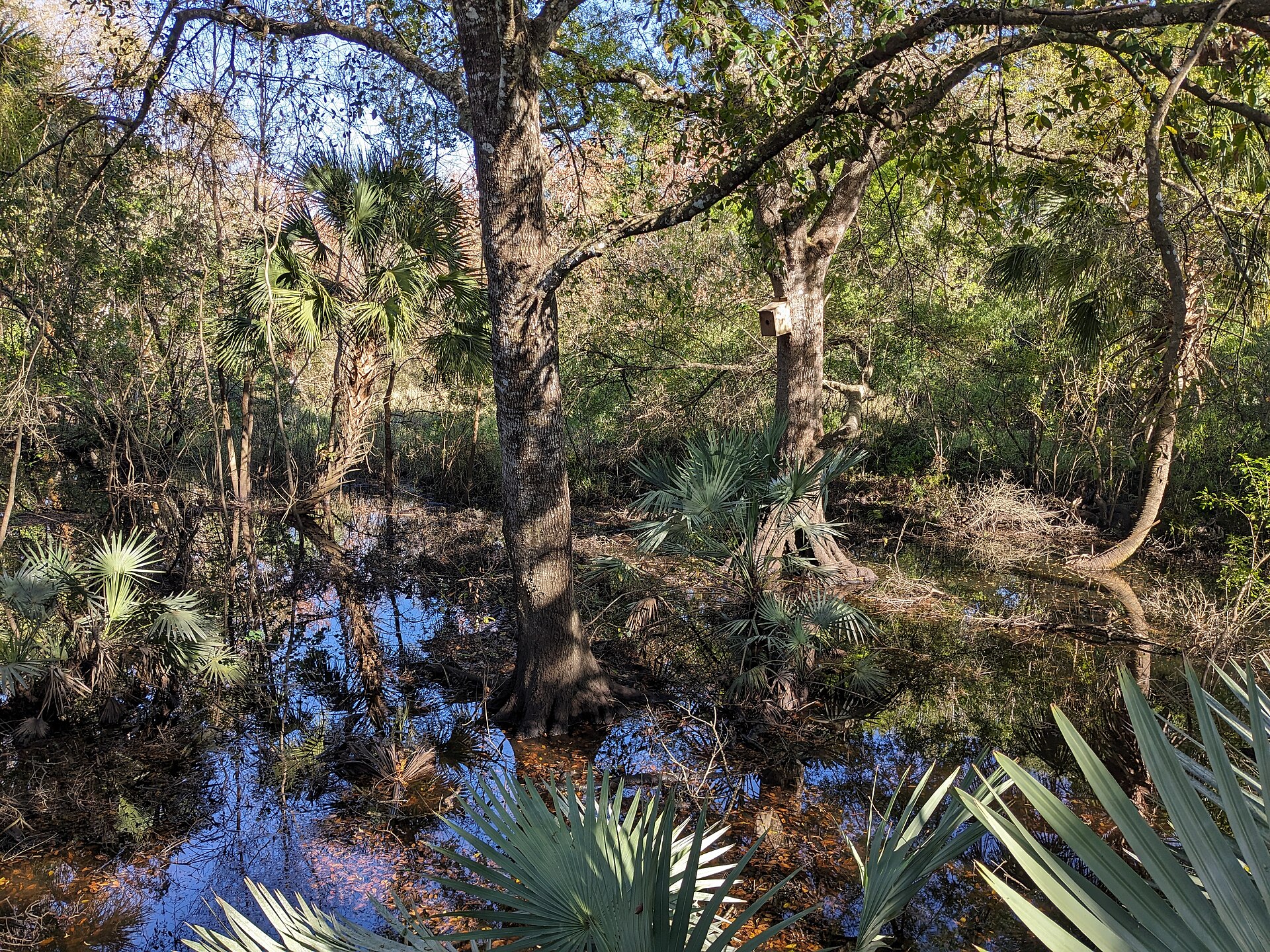
The plant community is characteristic of central Florida riverine hammock: bald cypress (Taxodium distichum) in the wetter zones, cabbage palm (Sabal palmetto) on the transition belts, southern magnolia, water oak, and live oak in the drier hammock. The understory includes saw palmetto, ferns, and various epiphytic bromeliads.
Wildlife includes the usual suite for this kind of habitat: alligators, common around the creek’s deeper pools; great blue herons, snowy egrets, anhingas, wood storks, several owl and woodpecker species. The Sanctuary is on the migration path for several neotropical songbird species in spring and fall.
The most spectacular wildlife use, however, is the West Indian manatee. Turkey Creek’s freshwater run delivers water that’s warmer than the lagoon’s surface temperatures in winter. Manatees, which cannot tolerate sustained cold-water exposure, use the creek as a thermal refuge during cold snaps. In a typical winter, multiple manatees can be observed from the Sanctuary’s boardwalks during cold-weather periods.
The boardwalks
The Sanctuary has an extensive boardwalk system that allows visitors to walk through the swamp and hammock without disturbing the substrate. The boardwalks are wheelchair-accessible across most of their length, with observation platforms at several points overlooking the creek’s deeper pools.
The Margaret Hames Nature Center, at the Sanctuary’s main entrance off Port Malabar Boulevard, provides interpretive exhibits, restrooms, and the trailhead for the boardwalk system. The Center is named for Margaret Hames, a local conservation advocate whose efforts contributed to the Sanctuary’s establishment.
The Sanctuary is open daily during daylight hours. There is no entry fee. The City of Palm Bay manages the property through its Parks and Recreation Department.
The Ais connection
The Turkey Creek shell midden complex, the multi-component archaeological site that documents Ais occupation of the area, runs along the bluffs above the creek. Some midden material lies within the Sanctuary boundary; some extends north onto adjacent private and city-owned parcels.
The Sanctuary’s interpretive signage acknowledges the Ais occupation in general terms. The Florida Master Site File entry for the Turkey Creek complex protects specific site coordinates from public disclosure to prevent looting. What a visitor can see, walking the boardwalks above the creek, is the landscape itself, the springs, the cypresses, the brackish-water transition at the creek’s mouth, which is what drew the Ais here and held them for centuries.
The Sanctuary is, in this sense, the closest thing Palm Bay has to a continuous link with its pre-Columbian human history. The Ais are not represented by descendants, by language, or by surviving cultural institutions. What remains of them is the archaeological record and the place. The place is still there.
The hydrology problem
The Sanctuary protects the creek’s lower reach but cannot protect the water that arrives there. Upstream of the Sanctuary boundary, Turkey Creek receives discharge from large portions of Palm Bay’s drainage canal system. By the time water reaches the Sanctuary’s eastern edge, it has already been mixed with stormwater runoff from neighborhoods, roads, and parking lots covering tens of thousands of acres.
The visible effect within the Sanctuary varies seasonally. During dry periods, the freshwater spring discharge dominates and the water is relatively clear. During major rain events, the creek carries higher turbidity, higher nutrient loads, and visible discoloration from upstream runoff.
The Sanctuary’s manatees, herons, alligators, and resident fish populations have all adapted to the modified hydrology. The wildlife is real and observable. But the ecological condition of the water is significantly degraded compared to the pre-1922 baseline, when the only runoff reaching the creek came from intact pine flatwoods and seasonal wetlands.
What got preserved and how
Turkey Creek Sanctuary was assembled in pieces. The City of Palm Bay acquired the core parcels in the 1970s and 1980s as the surrounding land was being developed. Local conservation advocates, including Margaret Hames, pressed for preservation of the creek corridor as a public natural area rather than allowing residential development on the bluffs.
The preservation effort was partial. Some bluff-top parcels north of the present Sanctuary boundary were developed for residential use. The Sanctuary as it exists is smaller than what would have been preserved under a more ambitious land-acquisition program. But the acquired core, 130 acres covering the most ecologically significant portions of the lower creek, was a meaningful win.
The Florida Communities Trust and various other state and federal land-conservation funding sources contributed to subsequent acquisitions. The Sanctuary’s current footprint reflects accumulated acquisitions from the 1970s through the early 2000s.
What the Sanctuary actually feels like
Walking the boardwalks on a clear winter morning, the Sanctuary feels older than the city around it. Sound damping is significant; the residential streets immediately west of the boundary are mostly inaudible from inside the hammock. Cypresses with knees several feet high crowd the boardwalk’s southern segments. The creek runs slow and reflective in the lower pools.
Manatees, when present, are typically visible from the eastern observation platforms. They surface briefly, exhale audibly, and drift back down. A single manatee can stay in the creek for hours during cold snaps. Multiple manatees stacked into the warmer pools is a routine winter sight.
In summer the temperature differential reverses. The creek’s spring discharge is cooler than the surrounding air, making the Sanctuary an unexpectedly comfortable place to be in July afternoons. The bird life is heaviest in spring and fall.
What the Sanctuary doesn’t feel like is a major destination. It draws regional visitors, particularly birders and photographers, but the visitor traffic is modest. The Sanctuary’s parking lots are large enough that they’re rarely full. Most Palm Bay residents have visited at least once; many haven’t returned.
Why it matters more than its size suggests
130 acres is small for a nature preserve in Florida. The state has parks an order of magnitude larger and protected wilderness areas larger still. What makes Turkey Creek Sanctuary disproportionately important is geographic context.
The Sanctuary preserves a remnant of the pre-1959 Palm Bay landscape inside a city of 120,000 people. It is the only place within the city where a visitor can stand in something resembling the ecosystem the Ais lived in, the citrus growers settled at the edge of, and the GDC platted around. Every other comparable hammock and swamp within Palm Bay’s city limits was drained or developed in the 1960s and 1970s.
The Sanctuary is a hedge against total amnesia. It doesn’t preserve the city’s pre-development character, that’s gone. It preserves a sample. And in a city built by deliberately erasing the landscape it sits on, a 130-acre sample is a real and unusual thing to have.
Further Reading
As an Amazon Associate we earn from qualifying purchases.